Titan is the only moon in the Solar System with a significant atmosphere. High amounts of methane in its atmosphere and an extremely cold surface (roughly -180 degrees Celsius!) lead to a hydrologic cycle similar to water on Earth, where methane rains out and forms expansive lakes. Photochemistry involving methane also leads to the creation of complex hydrocarbons that gives Titan its distinctive orange glow.
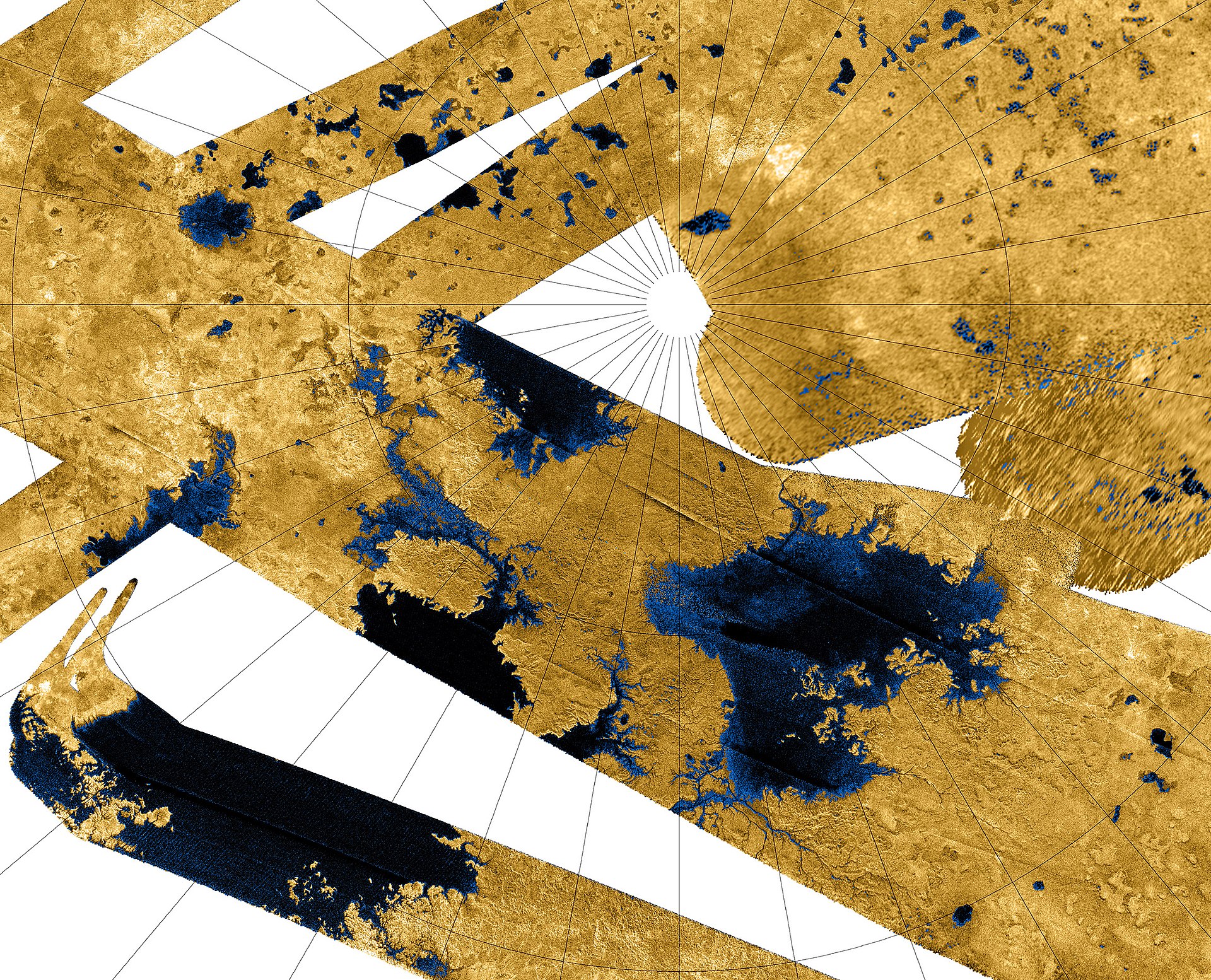 Cassini images of Titan’s surface reveal widespread methane/ethane lakes. Credit: NASA/JPL
While at NASA Goddard, I worked with advisor Conor Nixon to use data from the Spitzer Space Telescope to search for new molecules in Titan’s atmosphere. We were able to provide new data for spectroscopic models of Titan’s haze and found new signatures of propene in its atmosphere. Please read more about my work here. I am also part of the James Webb Space Telescope (JWST) Titan team, where we recently published a paper detecting CH3 and cloud formation on Titan for the first time. You can read more about it in the press release published by NASA here!
I was invited to present the following poster summarizing my work at the Planetary Systems and the Origins of Life in the Era of JWST conference.