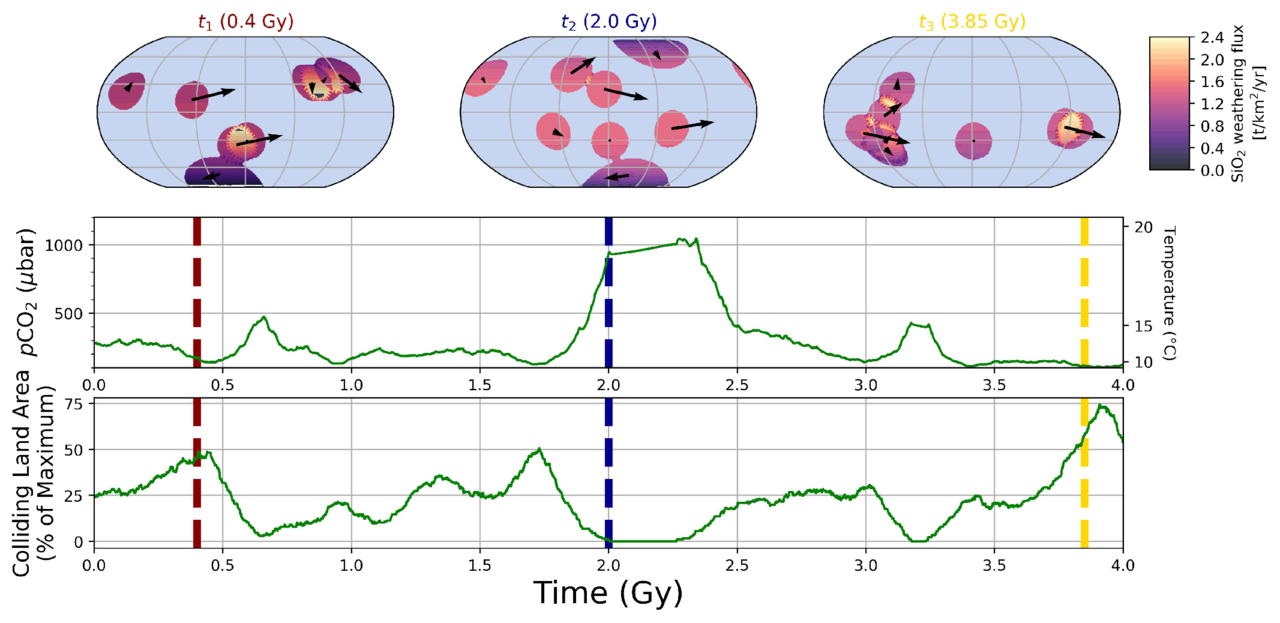
Understanding what conditions are required to keep planets habitable over geologic (~1 billion years) timescales is the first step toward identifying candidates for future searches for signs of life, for example with the upcoming Habitable Worlds Obsevatory. One process we think is important in maintaining Earth’s habitability is the carbonate silicate weathering feedback. This refers to the drawdown of CO2 (a major greenhouse gas) in the atmosphere via interaction of rainwater with surface rocks. If Earth warms, rain becomes more frequent and this process becomes more efficient, drawing down CO2 and cooling the surface. Vice-versa, if Earth cools, this process slows down and allows for more build-up of CO2 from volcanic outgassing. However, this process has a limitation—it becomes less efficient as surface rocks age and have less material available for this weathering process. We think that a resupply of surface rocks through processes like plate tectonics is thus required for carbonate silicate weathering to be effective on long timescales.
In 2025, I published a study modeling the senstivity of this process to the randomness of plate tectonic collisions, using a model developed by me title DISKWORLD. We found that additional processes resupplying surface rock, such as wind-driven dust transpot, glacial erosion, and seafloor weathering, are likely required in addition to tectonic collisions to keep Earth-like planets habitable over geologic timescales.