I am interested in studying the atmospheres of planets outside of our Solar System (`exoplanets’) to better understand our place in the cosmos. Currently, I focus on the smallest planets, typically between the size of Mercury and Neptune. With the advent of the James Webb Space Telescope, we can begin to study what their atmospheres and surfaces are made of through spectroscopic infrared observations.
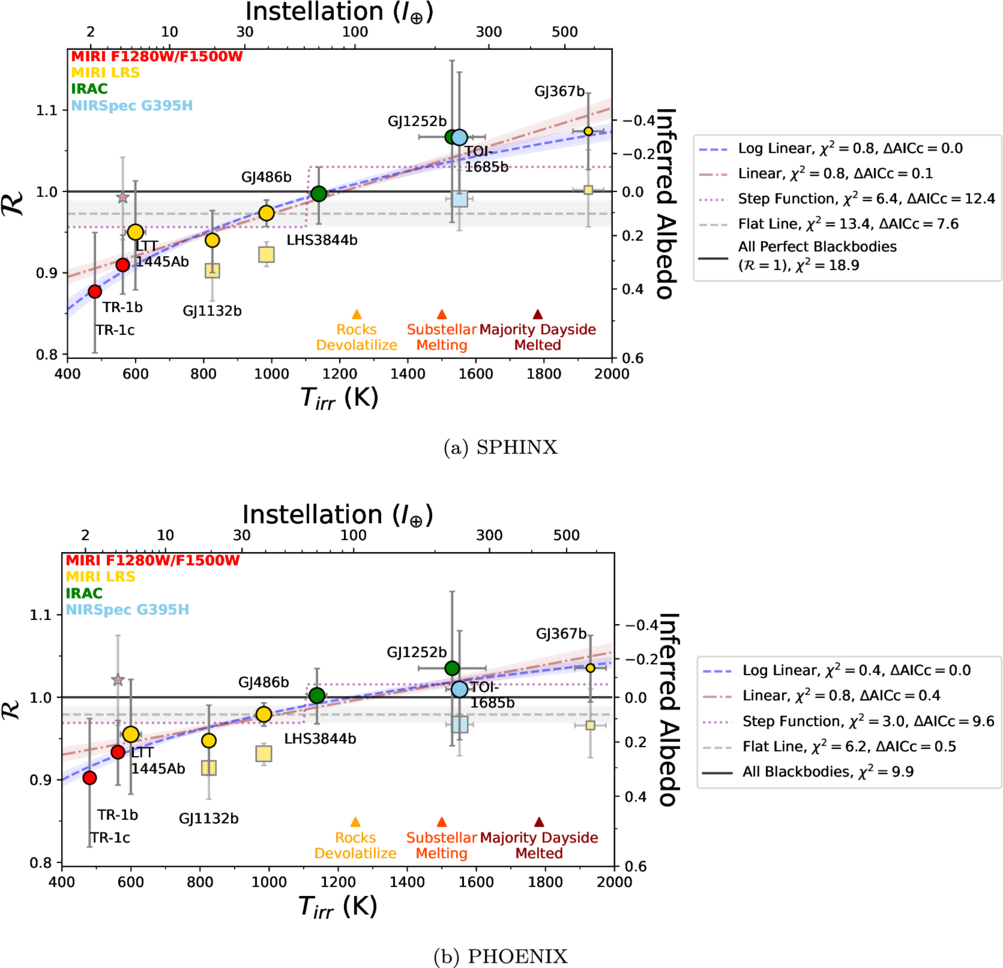
In 2025, collaborators and I published a study synthesizing our current observations of the thermal emission of Earth-sized terrestrial planets and what these observations can tell us about their surfaces and atmospheres. With thermal emission, we are directly seeing light being emitted by the planet itself, which can tell us about how reflective its surface is. We found potential evidence for a strong trend in planet temperature, with hotter planets on close-in orbits generally having darker surfaces. This can be explained by a process known a space weathering, which coats airless planets in a thin layer of dark iron particles.
I am the principal investigator for the JWST Cycle 3 Program 6284, Searching for Signatures of Surface-Atmosphere Interaction on a Small Planet in its Magma Era. The program aims to determine whether interaction between a small planet’s hydrogen-rich atmosphere and it’s liquid magma interior can noticeably affect its atmospheric composition. We think that Earth went through a similar hydrogen-atmosphere-liquid-surface phase very early in its lifetime that may have produced the water oceans that we see today.
I am also on the data interpretation teams for JWST GO 1743 (Constraining the Atmosphere of the Terrestrial Exoplanet Gl486b), JWST GO 1846 (A Search for Signatures of Volcanism and Geodynamics on the Hot Rocky Exoplanet LHS 3844b), JWST GO 3263 (The First Atmospheric Study of a Bona Fide Water World), JWST GO 4818 (A survey to search for silicate vapor atmospheres in the ultra-hot terrestrial planet population), JWST GO 4931 (Constraining the atmosphere of the terrestrial exoplanet TOI-4481b), and JWST GO 5263 (Observing the Atmosphere of a Pulsar Planet).